So there I was, writing an essay about Technique Without Taste with my superintelligent writing partner, bouncing things back and forth, getting some meaningful word count under our belts.
We were talking about how a writer’s technique is often very visible, and how their taste often isn’t. By taste we mean a kind of discretionary judgment: recognizing that something effective can still be wrong for this particular situation.
That’s Technique Without Taste: a creative technique gets used because it’s known historically to “work,” or because it’s recognized as a signature element of the creator’s style, rather than because the material actually calls for it.
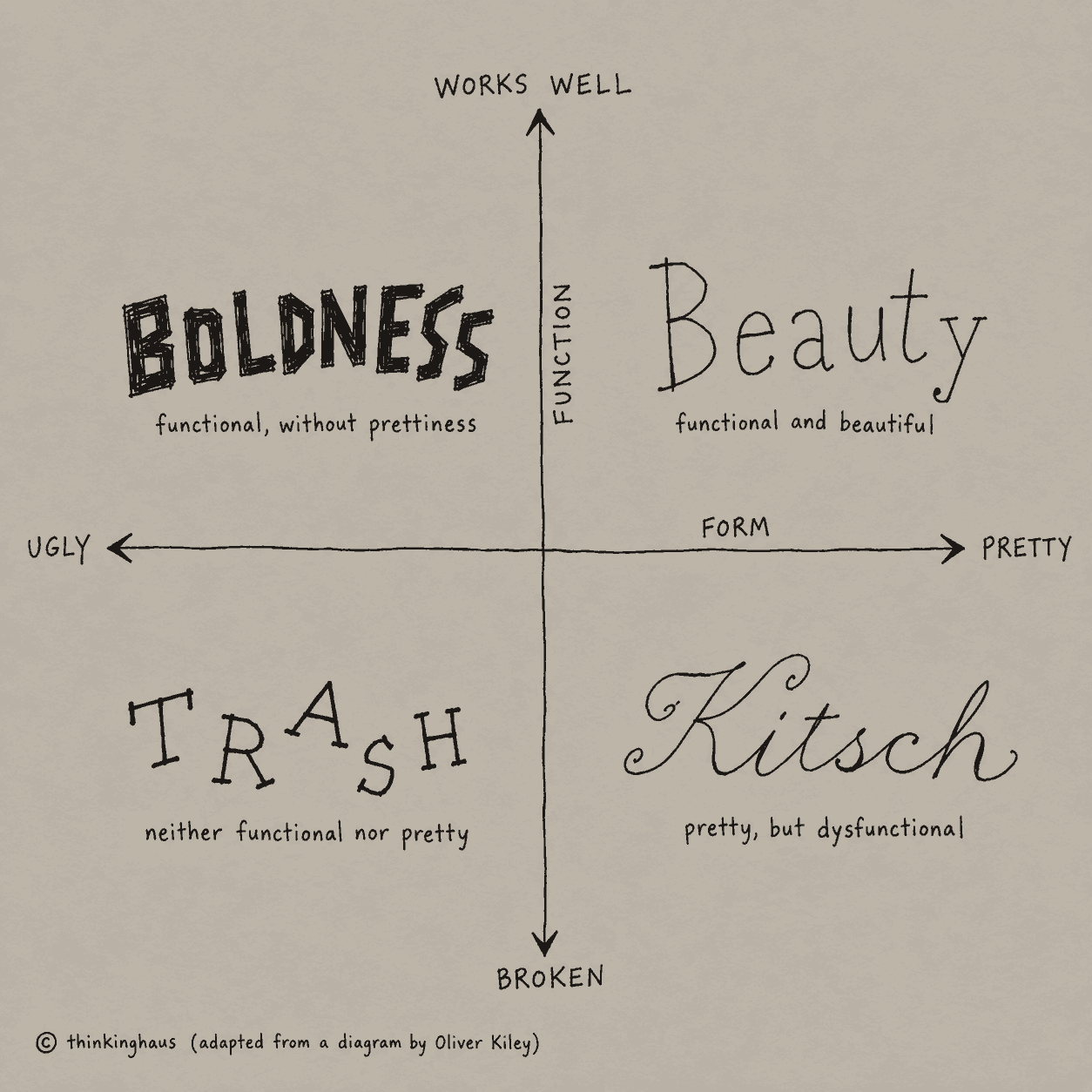
There’s a relationship here to kitsch, at least in the sense illustrated by the diagram below: form can look right while being wrong for the thing it’s supposed to do. Technique Without Taste is a kind of rhetorical version of that. The move may be attractive, polished, even effective on its own terms. It just doesn’t belong here.
Then we went through our draft looking for exactly the kind of failure we were describing. And, well, it wasn’t great. There were too many isolated sentences. Some jokes were doing useful work; most weren’t. A few thoughts were getting more force from their presentation than the thought beneath them warranted. I see you, dramatic one‑sentence paragraph.
So we removed them, and this complicated the issue. Now the AI had access to something it didn’t have in the finished essays I’d originally given it: rejection. It learned, at least locally, that this joke was too cute, this sentence didn’t need its own spotlight, this metaphor was trying too hard. The revision history contained evidence of choices that hadn’t survived.
That means it’s not quite right to say AI only sees what remains. In collaboration, we can show it what we reject too.
But those rejection patterns can themselves become constraints, and constraints can become recipes. Fewer one‑line paragraphs. Less ornamental metaphor. Humor that grows out of observation. All useful guidance. All potentially just another set of instructions.
Now instead of automatically inserting the joke, the model can automatically remove it. Taste still hasn’t manifested; the ruleset just became more sophisticated.
Taste is difficult to encode because it’s so contextual. The same joke can save one paragraph and cheapen another. The same metaphor can suddenly make something visible in one essay and turn into decorative fog in the next. A dramatic isolated sentence can be exactly right once and Paragraph Theater three pages later. There isn’t a stable rule that settles every case because the answer keeps depending on the material.
That’s why voice imitation is such a strange use case for AI. Suppose I show a model twenty essays I’ve written that I’m proud of. It notices things. I like humor. I sometimes let a mundane object carry a larger thought. I’m comfortable wandering. Maybe I tend to speak from personal experience.
None of those observations is wrong. But they can become instructions very easily. Now the model has a collection of reliable moves waiting to be deployed. It goes looking for somewhere to put the joke. A metaphor appears because this feels like the kind of paragraph where I might usually have one. The writing begins reproducing the evidence of judgment rather than exercising judgment itself.
Humor makes the problem easy to see because a good joke can start exerting pressure on everything around it. A distinction gets sharpened beyond what you quite believe because the exaggerated version is funnier. A paragraph starts serving the line instead of the thought. At that point the joke may still work; it’s just working for the wrong thing.
Metaphors do the same thing. So do deep‑cut references. So do those little one‑sentence paragraphs that acquire more importance from their isolation than from the thought inside them.
A good style guide should probably make those choices less automatic, not more. If humor is useful because it preserves human scale, sometimes preserving human scale means not making the joke. If metaphor is useful because it increases perception, a metaphor that merely decorates the thought has failed. If an associative leap belongs because it reveals an underlying relationship, surprise alone doesn’t justify it.
The technique isn’t the value. Whatever made the technique appropriate is the value.
That gives us a practical test, and the revision of this essay ended up becoming the test case. Alright then: take out the joke. Flatten the metaphor. Put the dramatic sentence back into its paragraph. Remove the offbeat reference. Make the ending boring. Then look at what you have left.
Sometimes the passage implodes, which tells you the technique was carrying real meaning. OK, put it back. Sometimes almost nothing changes except that the writing becomes less recognizably “good.” That’s useful information too.
I don’t want to turn this into an argument against recurring techniques. Writers obviously have them. A voice accumulates habits, even gimmicks, because the same person keeps encountering the world with some continuity. Someone who’s genuinely funny is probably going to keep being funny. Someone who thinks associatively will keep making associations.
The problem is reversing the causality. A living voice goes: I saw the thing like this, so the sentence came out like this. Technique Without Taste goes: My sentences tend to come out like this, so I need to find a thing for this sentence to do. That reversal is subtle enough that AI can make it look completely natural.
Which may be why the best intervention isn’t telling the model to stop using your favorite techniques. That just creates another rule for it to follow. Better to temporarily remove the move and force the passage to earn it back.
What does the joke reveal? What does the metaphor let me see? What does this strange reference change? Why is this sentence standing by itself?
If there’s a good answer, fine. If the answer is basically because this is how I write, that’s probably the moment to worry.
Last edited October 5, 2026